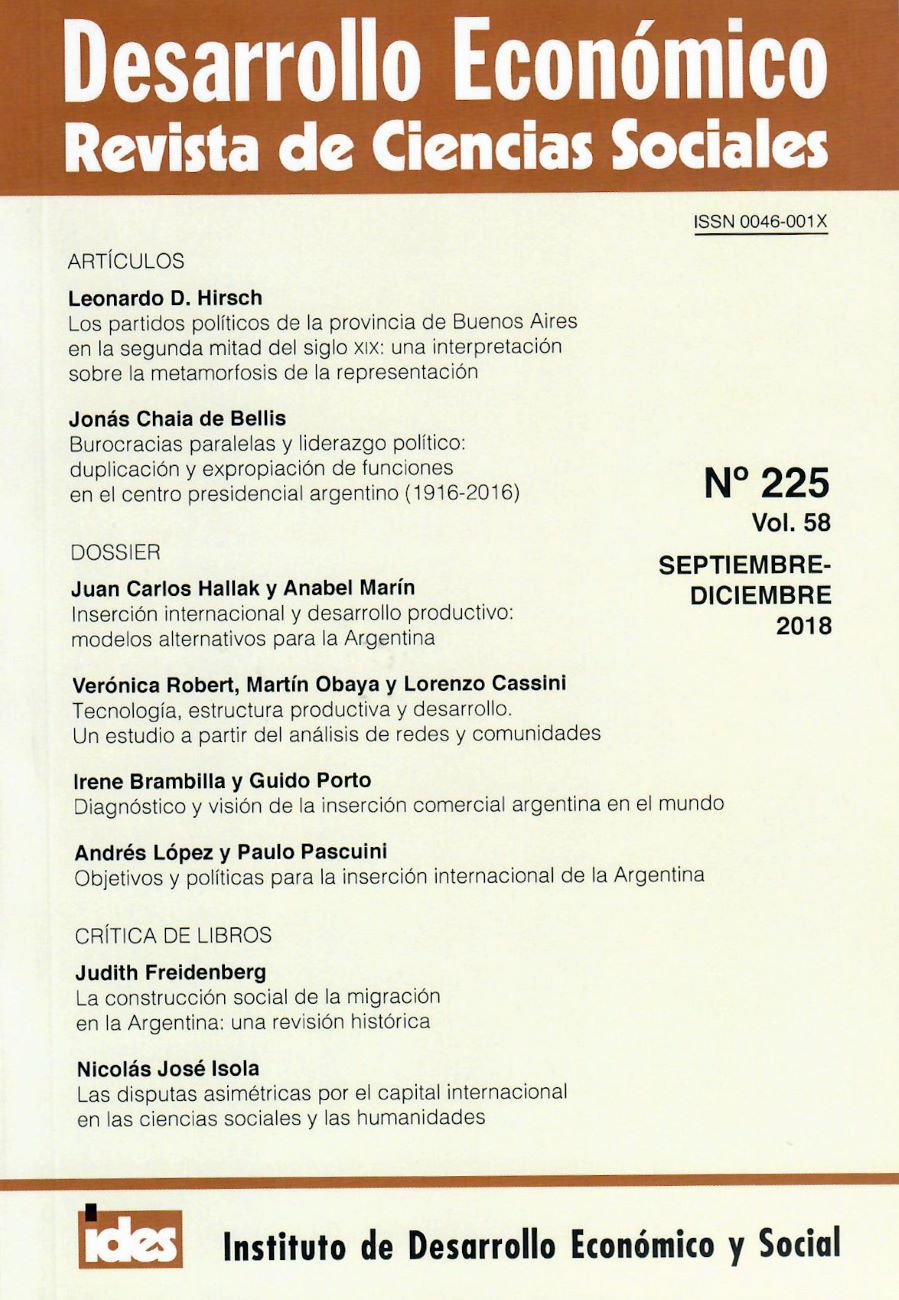
DIAGNOSIS AND VISION OF ARGENTINA'S COMMERCIAL INSERTION IN THE WORLD
Keywords:
Argentine exports, Differenciated products, Evolution of exportsAbstract
The objective of this paper is to evaluate the performance of Argentina in exports of goods. Its purpose is to build a diagnosis based on systematic criteria in order to characterize the pro- ducts exported by Argentina and also to discuss possibilities for the future. The main part of the analysis is based on indexes of product differentiation and technological content of exports that are computed for a sample of countries. Based on the content of product differentiation prevalent worldwide, the different products are defined as differentiated, with potential for differentiation, and homogeneous. One of the main conclusions of the paper is that a large part of Argentine exports belongs to the group of products with potential for differentiation, and that both product differentiation and diversification of export destinations could increase in order to raise total exported value, in particular in products related to the primary sector such as processed oils, meat and poultry, fruits and vegetables, other processed foods and beverages, and also chemicals and clothing.
Downloads
References
ABOAL, D.; ARZA, V. y ROVIRA, F. (2017). “Technological content of exports”, Economics of Innovation and New Technology, vol. 26, N° 7, pp. 661-682.
ARTOPOULOS, A.; FREIL, D. y HALLAK, J. C. (2013). “Export Emergence of Differentiated Goods from Developing Countries: Export Pioneers and Business Practices in Argentina”, Journal of Development Economics, vol. 105, pp. 19-35.
——— (2014). “Levantando el velo doméstico: el desafío de exportar bienes diferenciados a países desarrollados”, Desarrollo Económico, vol. 53, N° 211, pp. 285-311.
BAS, M. (2012). “Input-Trade Liberalization and Firm Export Decisions: Evidence from Argentina”, Journal of Development Economics, vol. 97, N° 2, pp. 481-493.
BERNARD, A.; JENSEN, J.; BRADFORD, J. y SCHOTT, P. (2006). “Survival of the best fit: Exposure to low-wage countries and the (uneven) growth of U.S. manufac- turing plants”, Journal of International Economics, vol. 68, N° 1, pp. 219-237.
BERNINI, F.; GONZÁLEZ, J.; HALLAK, J. C. y VICONDOA, A. (2018). “The Micro-D Classification: A New Approach to Identifying Differentiated Products”, Economía. LAcEA, en prensa.
BRAMBILLA, I.; DEPETRIS CHAUVIN, N. y PORTO, G. (2016). “Examining the Export Wage Premium in Developing Countrie’’, Review of International Economics, vol. 95, N° 3, pp. 447-475.
BRAMBILLA, I.; GALIANI, S. y PORTO, G. (2018). “Argentine Trade Policies in the XX Century: 60 Years of Solitude”, Latin American Economic Review, en prensa.
BRAMBILLA, I.; LEDERMAN, D. y PORTO, G. (2012). “Exports, Export Destinations and Skills”, American Economic Review, vol. 102, N° 7, pp. 3406-3438.
BRAMBILLA, I. y PORTO, G. (2016). “High-Income Export Destinations, Quality and Wages”, Journal of Inter- national Economics, vol. 98, pp. 21-35.
BUSTOS, P. (2011). “Trade Liberalization, Exports and Technology Upgrading: Evidence on the impact of MERCOSUR on Argentinean Firms”, American Economic Review, vol. 101, N° 1, pp. 304-340.
GALIANI, S. y SOMAINI, P. (2018). “Path-Dependent Import-Substitution Policies: The Case of Argentina in the 20th Century”, Latin American Economic Review, en prensa.
GERCHUNOFF, P. y LLACH, L. (2009). “Equality or Growth: A 20th Century Argentine Dilemma”, Journal of Iberian and Latin American Economic History, vol. XXVII, N° 3, pp. 397-426.
GROSSMAN, G. y HELPMAN, E. (1991). Innovation and Growth in the Global Economy. Cambridge, MA: MIT Press.
HALLAK, J. C. (2006). “Product Quality and the Direction of Trade”, Journal of International Economics, vol. 62, pp. 238-265.
HARTZICHRONOGLU, T. (1997). “Revision of the High-Technology Sector and Product Classification”, OECD Science, Technology and Industry Working Papers, 1997/2.
HAUSMANN, R.; HWANG, J. y RODRIK, D. (2007). “What you Export Matters”, Journal of Economic Growth, vol. 12, N° 1, pp. 1-25.
KUGLER, M. y VERHOOGEN, E. (2012). “Prices, Plant Size, and Product Quality”, Review of Economic Studies, vol. 79, N° 1, pp. 307-339.
LILEEVA, A. y TREFLER, D. (2010). “Improved Access to Foreign Markets Raises Plant-level Productivity... for Some Plants”, The Quarterly Journal of Economics, vol. 125, N° 3, pp. 1051-1099.
RAUCH, J. (1999). “Networks vs. Markets in International Trade”, Journal of International Economics, vol. 48, N° 1, pp. 7-35.
RODRIK, D. (2006). “What’s So Special about China’s Exports?”, China & World Economy, vol. 14, N° 5, pp. 1-19.
VERHOOGEN, E. (2008). “Trade, Quality Upgrading, and Wage Inequality in the Mexican Manufacturing Sector”, Quarterly Journal of Economics, vol. 123, N° 2, pp. 489-530.
YEAPLE, S. (2005). “A Simple Model of Firm Heterogeneity, International Trade and Wages”, Journal of International Economics, vol. 65, pp. 1-20.
Downloads
Published
Issue
Section
License

This work is licensed under a Creative Commons Attribution-NonCommercial-ShareAlike 4.0 International License.
Authors retain the copyright to their published work, but authorise the copying, distribution and creation of derivative works based on the original work, provided that the authorship of the work is always attributed in the manner specified by the author or licensor of the work. This licence does not, however, permit the use of the work or any derivative works for commercial purposes.
For their part, authors retain the rights to the work and guarantee that it is unpublished and original. Furthermore, authors grant *Desarrollo Económico. Revista de Ciencias Sociales* the non-exclusive right to publish their work electronically. Consequently, authors may retain the final versions and disseminate them in institutional or subject-specific repositories, on personal websites, or for any other relevant purpose, provided that the original source of publication is cited.