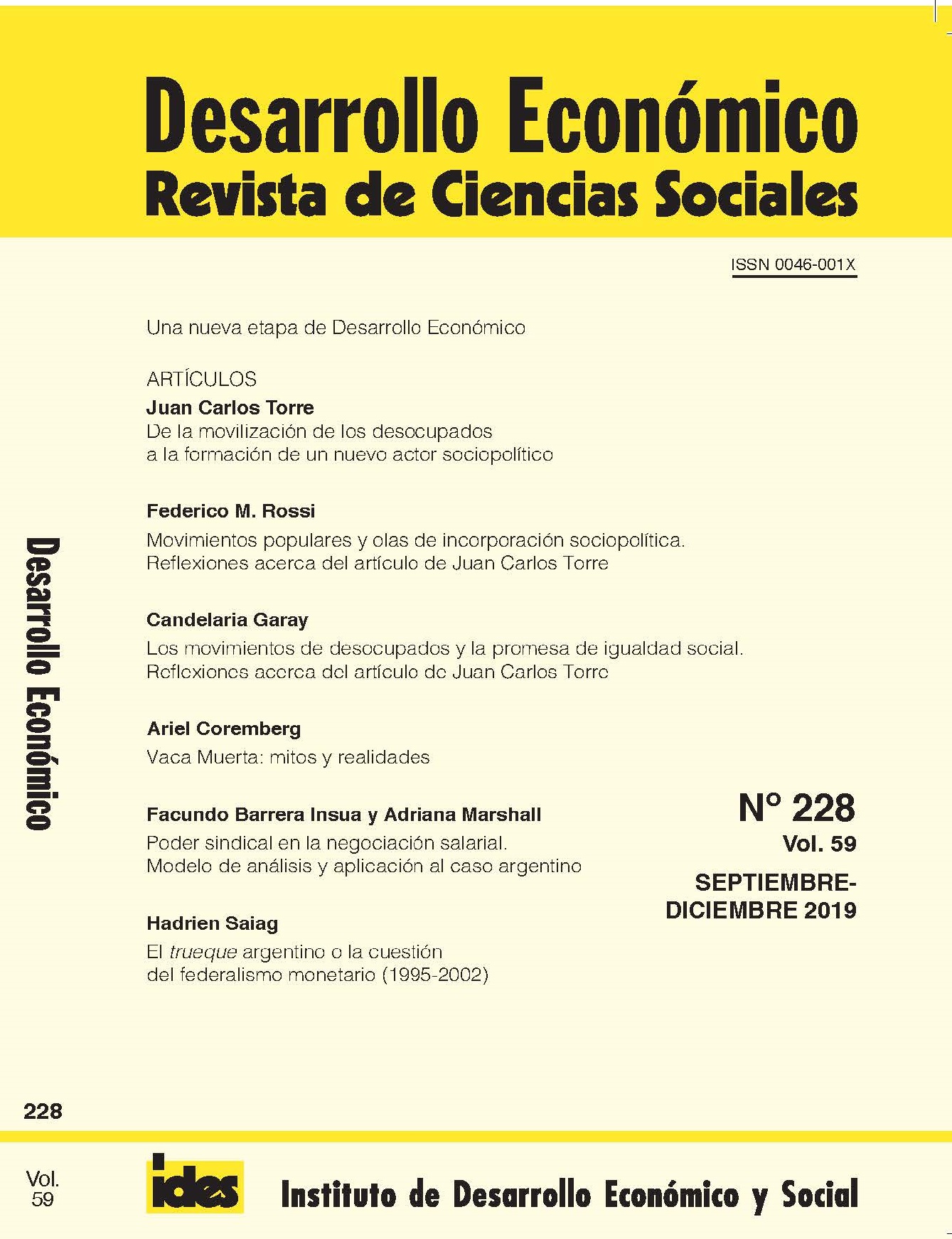
UNION POWER IN WAGE BARGAINING
MODEL OF ANALYSIS AND APPLICATION TO THE ARGENTINE CASE
Keywords:
Trade union power, Wage determination, Trade unions, Collective bargainingAbstract
Through a cross-industry study that focuses in the Argentinean private sector, we explore trade union power in wage bargaining considering three dimensions: its sources or determinants, union strategies in relation to how to exercise it, and bargaining results. Assuming that, once the influence of each sector´s ability to pay is controlled, relative wage levels would be the best indicators of trade union bargaining power, we analyze through multivariate regression models the effect on relative wages of three determinants of trade union power and of one variable expressing wage bargaining strategies. Power sources considered are the potential scope of a sectoral disruptive trade union action, that depends on each sector´s position in the system of interdependent economic relations (“strategic power”); the evolution of labour demand in each sector; and the associational capacity of trade unions, as reflected in each sector´s unionization rate. Bargaining strategies are gauged by way of unions´ propensity to take industrial action, expressed in the differential incidence of wage-related conflicts. Regression results indicate that, in the Argentinean case, strategic power and associational capacity as much as trade union strategies indeed contribute to explain wage differentials across economic activities. Therefore, these variables are also appropriate indicators for an empirical approximation to trade union power in wage bargaining.
Downloads
References
Armstrong, K. J., Bowers, D. y Burkitt, B. (1977). “The measurement of trade union bargaining power”, British Journal of Industrial Relations, vol. 15, N° 1, pp. 91-100.
Barrera Insua, F. (2015). “La acción sindical en el conflicto salarial de la Argentina post-convertibilidad (2006-2010)”, Sociedad y Economía, vol. 28, pp. 115-136.
——— (2017). “Desigualdad salarial sectorial en la Argentina (2003-2012): entre las características productivas de los capitales y la acción sindical”, tesis doctoral. Ciudad Autónoma de Buenos Aires: Universidad de Buenos Aires.
Betcherman, G. (1991). “Does technological change affect union wage bargaining power?”, British Journal of Industrial Relations, vol. 29, Nº 3, pp. 447-462.
Cambiasso, M. (2015). “Tradición de organización y estrategias sindicales. Un estudio sobre la organización sindical en la fábrica alimenticia Kraft-Mondelez (ex Terrabusi) en la post-convertibilidad”, tesis doctoral. Ciudad Autónoma de Buenos Aires: Universidad de Buenos Aires.
Cortés, F. y Jaramillo, A. (1980). “Relaciones de poder en los conflictos laborales”, Revista Mexicana de Sociología, vol. 42, Nº 2, pp. 799-833.
Crouch, C. (2017). “Membership density and trade union power”, Transfer: European Review of Labour and Research, vol. 23, Nº 1, pp. 47-61.
Duhalde, S. (2013). “Organización y acción en el sindicalismo de base en Argentina: un abordaje conceptual”, Revista de Sociologia e Política, vol. 21, Nº 48, pp. 161-177.
Korpi, W. (1998). “Power resources approach vs. action and conflict: on causal and intentional explanations in the study of power”, en O’Connor, J. S. y Gregg, M. O. (eds.), Power Resource Theory ant the Welfare State: A Critical Approach. Toronto: University of Toronto Press, pp. 37-69.
Lévesque, C. y Murray, G. (2010). “Understanding union power: resources and capabilities for renewing union capacity”, Transfer: European Review of Labour and Research, vol. 16, Nº 3, pp. 333-350.
Malizia, E. y Bond, D. L. (1974). “Empirical tests of the ras method of interindustry coefficient adjustment”, Journal of Regional Science, vol. 14, Nº 3, pp. 355-365.
Marshall, A. y Groisman, F. (2005). “Afiliación sindical en la Argentina: incidencia de características personales y del empleo, 1990-2001”, Estudios del Trabajo, Nº 29, enero-junio, pp. 15-40.
mteyss [Ministerio de Trabajo, Empleo y Seguridad Social] (2016). “La conflictividad laboral durante el año 2016”. Disponible en .
Murillo, M. V. (1997). “La adaptación del sindicalismo argentino a las reformas de mercado en la primera presidencia de Menem”, Desarrollo Económico. Revista de Ciencias Sociales, vol. 37, Nº 147, octubre-diciembre, Buenos Aires, ides, pp. 419-446.
——— (2001). Labor Unions, Partisan Coalitions, and Market Reforms in Latin America. Cambridge: Cambridge University Press.
Peetz, D. y Pocock, B. (2009). “An analysis of workplace representatives, union power and democracy in Australia”, British Journal of Industrial Relations, vol. 47, Nº 4, pp. 623-652.
Perrone, L. (1983). “Positional power and propensity to strike”, Politics & Society, vol. 12, Nº 2, pp. 231-261.
———, Wright, E. O. y Griffin, L. J. (1984). “Positional power, strikes and wages”, American Sociological Review, vol. 49, Nº 3, pp. 412-426. Disponible en <https://doi.org/10.2307/2095284>.
Rigby, M. y García Calavia, M. Á. (2018). “Institutional resources as a source of trade union power in Southern Europe”, European Journal of Industrial Relations, vol. 24, Nº 2, pp. 129-143.
Schuschny, A. R. (2005). Tópicos sobre el modelo de insumo-producto: teoría y aplicaciones. Santiago de Chile: cepal. Disponible en <https://repositorio.cepal.org/handle/11362/4737>.
Usmani, A. (2017). “Development and Its Discontents”. Nueva York: New York University, mimeo.
Wallace, M., Griffin, L. J. y Rubin, B. A. (1989). “The positional power of American labor, 1963-1977”, American Sociological Review, vol. 54, Nº 2, pp. 197-214.
Womack, J. J. (2007). Posición estratégica y fuerza obrera: hacia una nueva historia de los movimientos obreros, Orensanz Escofet, L. (trad.). México: Fondo de Cultura Económica.
Wright, E. O. (2000). “Working-class power, capitalist-class interests, and class compromise”, American Journal of Sociology, vol. 105, Nº 4, pp. 957-1002.
Downloads
Published
Issue
Section
License

This work is licensed under a Creative Commons Attribution-NonCommercial-ShareAlike 4.0 International License.
Authors retain the copyright to their published work, but authorise the copying, distribution and creation of derivative works based on the original work, provided that the authorship of the work is always attributed in the manner specified by the author or licensor of the work. This licence does not, however, permit the use of the work or any derivative works for commercial purposes.
For their part, authors retain the rights to the work and guarantee that it is unpublished and original. Furthermore, authors grant *Desarrollo Económico. Revista de Ciencias Sociales* the non-exclusive right to publish their work electronically. Consequently, authors may retain the final versions and disseminate them in institutional or subject-specific repositories, on personal websites, or for any other relevant purpose, provided that the original source of publication is cited.